25 Essential Digital Marketing Terms for Winning Affiliate Campaigns
If you're new to affiliate marketing, the terminology can feel overwhelming. CTR, CPA, CPL, ROI—what do these acronyms actually mean, and why do they matter?
This guide breaks down 25 essential digital marketing terms you'll encounter as an affiliate marketer. Each term is explained in plain language with simple examples, so you can understand not just what these words mean, but how they affect whether you make money or lose it.
Think of this as your reference guide. Bookmark it and come back whenever you encounter a term you don't understand. If you're completely new to affiliate marketing, start with our complete beginner's guide to sweepstakes affiliate marketing to understand how everything fits together first.
Core Strategy & Optimization Terms
1. Affiliate Marketing
Affiliate marketing is a way to earn money by promoting other people's products or services. You don't need to create your own product or handle customer service—you just send people to an offer and get paid when they take a specific action.
Here's how it works: A company (the advertiser) wants more customers. You (the affiliate) send them traffic through your ads or content. When someone completes an action like signing up, making a purchase, or filling out a form, you earn a commission.
Simple Example:
You run a campaign and collect 100 email addresses. The advertiser only accepts 70 of them because 30 were fake emails or didn't meet their criteria. You get paid for 70 leads, not 100.
2. Lead Generation
Lead generation means collecting user information like email addresses or phone numbers that you get paid for. In affiliate marketing, you're often paid just for getting someone to fill out a form—they don't need to buy anything.
The catch is that not all leads get accepted. Advertisers check if the information is real and if the person meets their requirements. If someone uses a fake email or doesn't match what the advertiser wants, that lead gets rejected and you don't get paid.
Simple Example:
A call-to-action is the button or link that tells people what to do next. It's usually phrases like "Click Here," "Sign Up Now," "Get Started," or "Claim Your Entry."
The words you use matter. "Claim Your Prize" sounds more exciting than "Submit Form." Testing different CTA text can increase how many people click by 10-20%.
Tips: Make your CTA clear and specific. Instead of just "Click Here," try "Enter to Win" or "Check if You Qualify" tell people exactly what happens when they click.
An impression is counted every time your ad is shown to someone. If your ad appears on 1,000 screens. That’s 1,000 impressions, even if nobody clicks it. Impressions tell you how many people saw your ad, but not whether they cared about it. That’s why impressions alone don’t tell you if your campaign is working.
A click happens when someone actually clicks on your ad. This is the first sign that someone is interested in what you're offering.
More clicks isn't always better. If 1,000 people click but nobody signs up, you're wasting money. You want clicks from people who will actually complete the action you're being paid for.
CTR is the percentage of people who click your ad after seeing it: (clicks ÷ impressions) × 100. It reflects how well creative, messaging, and targeting resonate with the audience.
Benchmarks by traffic source:
Low CTR means your creatives or targeting is off. High CTR with low conversion usually means your ad is overpromised or your audience is too broad.
Tips: Test CTA copy, color, and placement. Small changes often produce 10-20% lift in click through
Conversion Rate shows the percentage of users who complete the desired action after clicking. This could be a signup, registration, or purchase, (conversions ÷ clicks) × 100. You can have amazing CTR and still lose money if CR is bad. A 5% CTR with 1% CR is worse than 2% CTR with 5% CR.
Benchmarks:
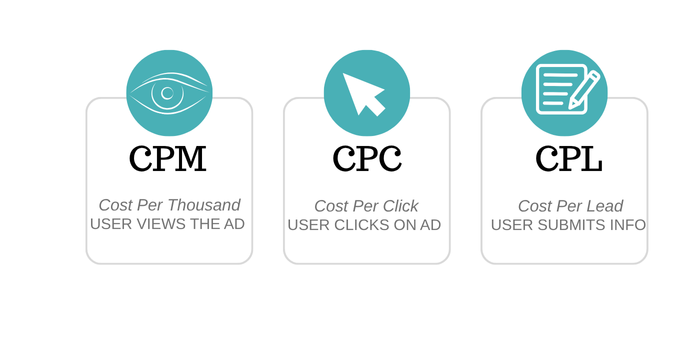
CPC is how much you pay every time someone clicks your ad. On Facebook, CPCs range from $0.10 to $2.00+. On native networks, $0.05 to $0.50 is typical.
Why it matters: Lower CPC isn't always better. If you're paying $0.10 per click but only 1% converts, your CPA is $10. If you're paying $0.50 per click but 10% converts, your CPA is $5.
Simple Example:
Important: A lower CPC doesn't automatically mean you're making more money. If you pay $0.10 per click but only 1 out of 100 people converts, versus paying $0.50 per click but 10 out of 100 convert, the second option makes you more money even though each click costs more.
CPM refers to the cost of 1,000 ad impressions. It is commonly used in display, native, and social advertising, especially for campaigns focused on awareness or top of funnel exposure.
Simple Example:
CPL is how much you spend to acquire one lead: total spend ÷ total leads.
Simple Example:
Why it matters: If you're getting paid $6 per lead and it costs you $4 to get each lead, you're making $2 profit per lead. If it costs you $7 to get a lead but you only get paid $6, you're losing $1 per lead. Your margin requirements change based on which geos you're running tier 1 countries often need tighter margins due to higher competition.
Common mistake: Focusing only on CPL without checking lead quality. A $3 CPL sounds great until 50% of leads get rejected and your effective CPL is $6.
CPA represents the cost of generating a completed action, such as a qualified signup or sale. It is one of the most widely used pricing models in affiliate marketing : total spend ÷ conversions. It’s similar to CPL but can refer to any type of conversion, not just leads.
Why it matters: If CPA is higher than payout, you're losing money. Aim for CPA at 60-80% of payout. If payout is $50, target $30-$40 to leave room for testing and variance.
ROI tells you how much money you made compared to how much you spent. It's the most important number for knowing if your campaign is actually making money: [(revenue - cost) ÷ cost] × 100.
Example Calculation:
Here's an important lesson: A higher ROI percentage doesn't always mean more money. Look at this:
Positive ROI confirms that a campaign can be maintained or scaled, while negative ROI signals inefficiency. ROI modeling becomes especially important when working with multiple geos, as outlined in smartlink traffic strategy guide.
Your target audience is the specific group of people you want to reach with your ads. Instead of showing your ad to everyone, you pick characteristics like age, location, interests, or behaviors.
Simple Example:
Better targeting means less wasted money on people who will never be interested in what you're promoting.
Demographics are basic facts about people: age, gender, location, language, device type. When you set up ads, you can choose which demographics to target.
Common Demographic Targeting Options:
Optimization means making changes to improve your campaign's performance. This could be changing your ad image, adjusting who sees your ads, or tweaking your landing page.
The key is to test one thing at a time. If you change your ad image, targeting, and landing page all at once, you won't know which change actually helped. Programmatic specific optimization tactics are detailed in Sweepstakes on Programmatic Ads.
A/B testing is the process of comparing two or more variations of a creative, landing page, or CTA to determine which performs better. You might test two different ad images, two different headlines, or two different landing pages.
Simple Example:
Engagement means how people interact with your content beyond just clicking. On social media, this includes likes, comments, shares, and video views.
While engagement doesn't directly make you money in affiliate marketing, it can help your ads perform better. Social platforms show ads with higher engagement to more people because they think the ad is more interesting.
PPC means you only pay when someone actually clicks your ad, not when they just see it. This is the opposite of CPM (where you pay per impression). Most affiliate marketers use PPC advertising. Platforms like Google Ads, Facebook Ads, and most native ad networks operate on a PPC model.
SEO is the practice of getting free traffic from search engines like Google by creating content that ranks well for keywords people search for. Unlike paid ads where you pay for every click, SEO traffic is free once you rank. However, it takes much longer to get results—usually months instead of days.
According to Google’s official SEO Starter Guide, ranking well requires both quality content and proper technical setup.
Simple Example:
Email marketing means sending promotional messages to people's email inboxes. In affiliate marketing, you often collect emails through one campaign, then send more offers to those same people later. This is valuable because you can make money from the same person multiple times. Someone who entered one sweepstakes might be interested in others you promote.
User generated content is reviews, photos, videos, or testimonials created by real users, not by you or the advertiser. This includes things like customer reviews, unboxing videos, or social media posts from real customers. UGC makes your promotions more trustworthy. People trust real user reviews more than marketing messages from companies.
Brand awareness is how familiar people are with a product, company, or offer. When people recognize a brand, they're more likely to trust it and convert. In affiliate marketing, this matters because well known brands usually convert better than unknown brands. A sweepstakes from a recognizable company will typically get more signups than one from a company nobody has heard of.
Learning these terms is just the first step. The real learning happens when you start running campaigns and seeing how these numbers play out with real money.
Here's what to focus on as a beginner:
Your First Campaign Checklist:
Don't try to master everything at once. Start with one traffic source, one offer type, and focus on understanding these core metrics. As you get comfortable, you can explore more advanced strategies. If you’re looking to apply these concepts in real sweepstakes or affiliate campaigns, working with a specialized network can shorten the learning curve.
You run a campaign and collect 100 email addresses. The advertiser only accepts 70 of them because 30 were fake emails or didn't meet their criteria. You get paid for 70 leads, not 100. To understand how lead quality affects approvals, payouts, and long term performance, you can read our
4. Call-to-Action (CTA)
Performance Metrics That Drive Decisions
5. Impressions
6. Clicks
7. Click Through Rate (CTR)
Native: 0.5-2%
Push: 0.2-0.5%
Facebook/social: 1-3%
Search: 2-8% for branded, 0.5-2% for cold
8. Conversion Rate (CR)
Sweepstakes on native might convert at 8-15%. Finance lead gen on Facebook might hit 2-4%. Dating SOI on push might reach 10-20%. Always compare your CR to others running the same offer and traffic source.
Cost Models & Affiliate Economics
9. Cost Per Click (CPC)
You spent $100 on ads
You got 200 clicks
Your CPC = $100 ÷ 200 = $0.50 per click
10. Cost Per Mille (CPM)
A platform charges $5 CPM
This means you pay $5 for every 1,000 times your ad is shown
If your ad shows 50,000 times, you pay $250
11. Cost Per Lead (CPL)
You spent $100 on ads
You got 25 people to sign up
Your CPL = $100 ÷ 25 = $4 per lead
12. Cost Per Acquisition (CPA)
Understanding Your Profit
13. Return on Investment (ROI)
You spent $1,000 on ads
You earned $1,500 from conversions
ROI = [($1,500 - $1,000) ÷ $1,000] × 100 = 50%
This means you made 50 cents profit for every dollar you spent.
Campaign A: Spent $100, Made $300 = 200% ROI, but only $200 profit
Campaign B: Spent $10,000, Made $13,000 = 30% ROI, but $3,000 profit
Result: Campaign B made you more actual money even though the ROI percentage was lower.
16. Target Audience
If you're promoting sweepstakes to win beauty products, you might target women aged 25-45 who are interested in makeup and skincare, rather than showing it to everyone.
17. Demographics
Age range (18-24, 25-34, 35-44, etc.)
Gender (male, female, all)
Location (country, state, city)
Device (mobile, desktop, tablet)
Language
Understanding Optimization
18. Campaign Optimization
19. A/B Testing
Version A: Ad headline says "Win a Free iPhone!"
Version B: Ad headline says "Enter to Win the Latest iPhone 16!"
You run both versions with the same budget. After a few days, Version B has a 2.5% CTR while Version A only has 1.8%. You keep Version B and stop Version A.
20. Engagement
Marketing Channels
21. PPC (Pay-Per-Click) Advertising
22. SEO (Search Engine Optimization)
You write an article titled "How to Win Sweepstakes: 10 Pro Tips." When people search for "how to win sweepstakes" on Google, your article shows up. You include affiliate links to sweepstakes offers in the article.
23. Email Marketing
24. User Generated Content (UGC)
25. Brand Awareness
Final Takeaway
Track your CTR: Are people clicking your ads?
Track your conversion rate: Are clicks turning into signups?
Calculate your CPA: How much does each conversion cost you?
Compare CPA to payout: Are you making money or losing it?
Make small changes: Test one thing at a time